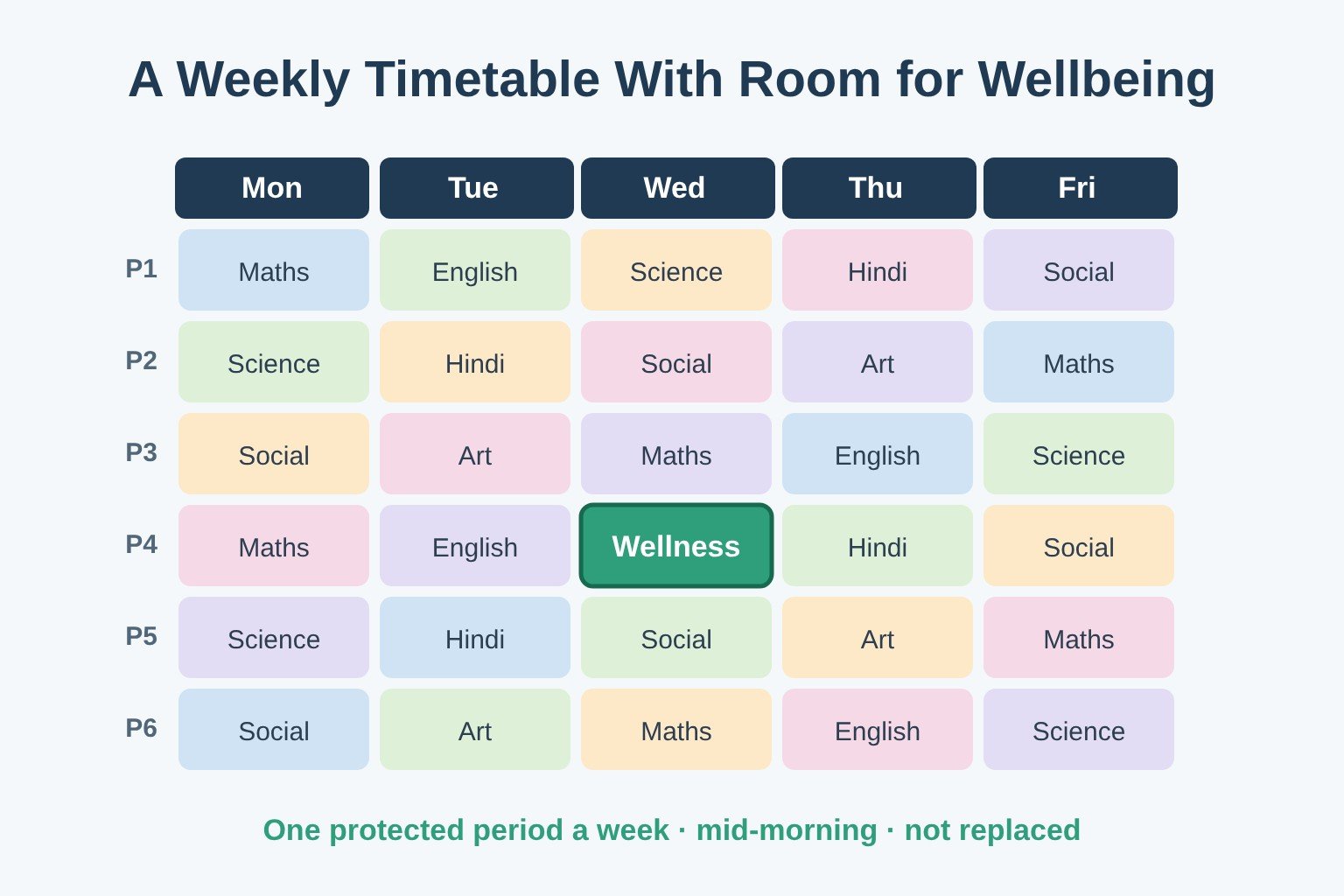
Eight periods during the day and not a single one dedicated to the welfare of the child. This is why a wellness period school timetable slot has moved from a nice idea to something principals now consider while building the schedule. Teachers can spot a withdrawn child, but they need extra time to do so.
What a weekly wellness class is
It is neither a free period nor physical education renamed. The weekly wellness class is a dedicated time, usually around 35 to 45 minutes long, when students build skills in emotional literacy, coping with stress and seeking support. It has a place on the timetable equal to any other class, such as mathematics or literature.
That is how a school wellness curriculum differs from a wellness day once a year. The latter provides a snapshot for the newsletter. The former helps to develop the habit.
Why schools are doing this now
One reason is the numbers. According to WHO’s 2025 fact sheet, around one in every seven (14.3%) young people aged 10 to 19 lives with a mental health condition, and WHO advocates a supportive environment in schools for adolescents.
The other is pressure from above. The Supreme Court’s directives of 25 July 2025 include provisions for schools, colleges and coaching institutes. The Court emphasised mental awareness, emotional regulation and life skills development in orientation programmes and extracurricular activities. It also directed that every institution with more than 100 students should have at least one counsellor, psychologist or social worker.
The court is not directing schools to create a period. However, where a school already employs a counsellor and is responsible for running mental health literacy programmes, those programmes need an allocated space. The wellness period is the obvious choice.
What Indian schools have already tried
This isn’t imported theory. Indian schools have been testing it for years.
| Initiative | Where | What it set aside |
|---|---|---|
| Happiness Curriculum | Delhi government schools | Compulsory 45-minute daily lessons across more than 1,000 schools |
| PLAY initiative | Tamil Nadu, 2026-27 | A revised timetable for classes 1 to 12 giving sports and other activities a defined place |
| Health and PE period | CBSE, 2018-19 session | One period reserved for health and physical education |
Delhi went furthest. According to Brookings, the programme ran for 45 minutes. The sessions were activity-based, with no formal exams on them, and each one began with a short mindfulness exercise before moving into other activities. You don’t need a daily slot to copy the idea. Most private schools will start with once a week.
What belongs in a school wellness curriculum
Don’t invent this from scratch. The government’s health and wellness curriculum framework, developed by NCERT and the Ministries of Education and Health, is built around eleven themes, and CBSE publishes school health manuals developed with guidance from WHO India. Both are free and a decent starting point.
A few topics earn their time quickly:
- Naming emotions and coping with them, especially before examinations
- Sleep and screen use
- Friendship, arguments and peer pressure
- Body changes during the transition period
- Finding people to talk to, and how to approach them
Keep sessions practical. Twenty minutes of discussion and a short exercise beats a lecture on “stress management” every time.
Where a wellness period school timetable slot works best
This is where most plans falter.
One Delhi teacher pointed out, as reported by Teacher Plus, that co-scholastic activities such as wellness and physical education are often scheduled in the afternoons, starting from the sixth period. The wellness session ends up at the time when all other classes have ended: the last period on a Friday, when half the class has not shown up.
A few measures ease this. Schedule it mid-morning or right after lunch, when students are present. Rotate the slot so it doesn’t replace the same class each time. And protect it during examination time.
What goes wrong
In one essay by a student in the United States about a newly introduced wellness period at his high school, most students took it lightly and spent the time on their phones and games rather than taking part. The period had no structure and was simply free time.
Three problems come up again and again:
Where to start
Don’t redo the whole day. For a wellness period school timetable pilot, choose one class and set aside 40 minutes once a week for one term. Run it with your counsellor, and ask the students what they would like changed. If you need help setting up the pilot, talk to Soul and Mind.



















0 Comments