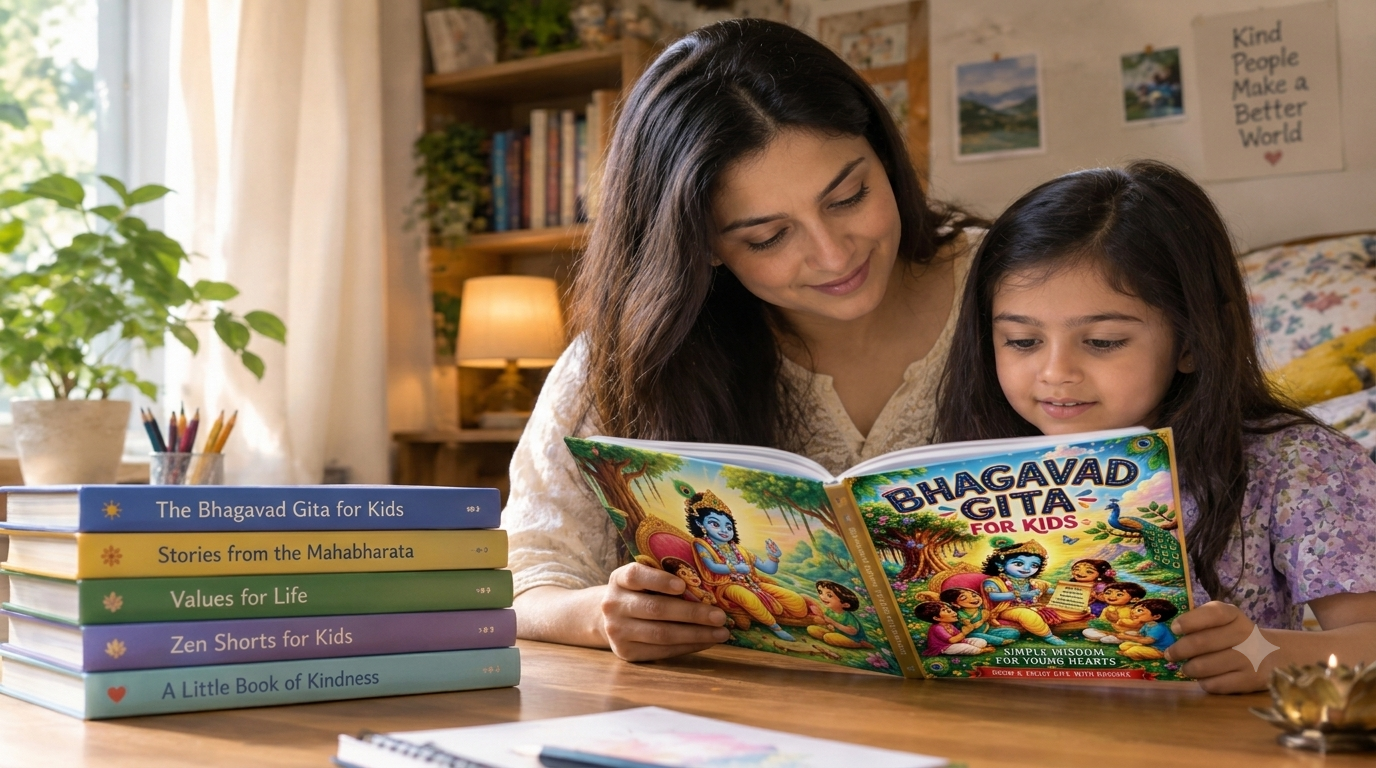
You’re standing in a bookshop, or scrolling an app, and every spiritual book for kids says “ages 4 and up.” Your five-year-old and your eleven-year-old can’t want the same thing. Choosing spiritual books for children by age sounds easy until you notice that the number on the cover is a publisher’s estimate, not a measure of what your child is ready to hear.
The usual advice on age appropriate books for children starts and ends with reading level. For spiritual books, that covers only half the problem. This guide gives you a way to decide, a short age-by-age list with real titles, and a plain take on starting the Bhagavad Gita with children.
Why the age on the cover isn’t enough
Labels are applied loosely. The Bhaktivedanta Manor shop lists Bhagavad Gita for Children as suitable for ages 3 to 6, while BookSetGo lists Sudha Gupta’s Pegasus edition, which carries the same description, as 4+. The same retailer lists Shubha Vilas’s Illustrated Bhagavad Gita for Children as 8+. One scripture, three different starting points.
Two separate questions hide behind an age label. Reading level is whether a child can decode the words. Readiness is whether the idea itself, whether it’s duty, loss, God or the self, makes sense to them yet. A strong eight-year-old reader can get through a verse about the soul and still find it baffling, or a little frightening.
India’s school framework points the same way. According to a CBSE circular on NCF-2023, the Foundational Stage runs from pre-primary to Grade 2, ages 3 to 8, and its learning outcomes are predominantly oral and experiential. The Preparatory Stage covers Grades 3 to 5, ages 8 to 11. In practice, that means below about eight, a spiritual book is mostly something you read aloud and talk about, not something a child studies alone.
Research doesn’t hand us a tidy formula either. A 2004 concept analysis by Joanna Smith and Wilfred McSherry, based on five research papers, found that children’s spiritual thinking is diverse and complex, and looked at how it shows up at different developmental stages. So treat age bands as a starting point, then watch your own child.
Spiritual books for children by age: a quick guide
Here’s a starting list of the best spiritual books for kids at each stage. Ages in brackets come from the retailer or reviewer named, not from us.
| Age | What tends to work | Titles to look at | Hold back |
|---|---|---|---|
| 3 to 5 | Very short picture books, read aloud, about wonder, kindness and nature | Remember by Joy Harjo, illustrated by Michaela Goade (2023, listed 4 to 8 on Bookroo, 163 words) | Death, the afterlife, anything built on fear |
| 6 to 8 | Stories with one clear character and one idea | Bhagavad Gita for Kids by Rita Gandhi (a House Full of Books reviewer suggests 6+); Bhagavad Gita for Children by Sudha Gupta (Pegasus, 192 pages, listed 4+) | Battlefield detail, abstract philosophy |
| 9 to 12 | Parables and illustrated retellings with questions to think about | Illustrated Bhagavad Gita for Children by Shubha Vilas (Wonder House Books, 2024, listed 8+); Zen Shorts and The Three Questions by Jon J. Muth | Dense, metaphor-heavy poetry such as The Prophet, which one Shortform list flags as challenging even for 10-year-olds |
| 13 and up | Shorter original texts, a simplified Gita, and room to argue | A plain-language Gita with commentary, then a fuller translation when they ask for more | Handing over a text with no space for questions |
Best spiritual books for kids: a checklist before you buy
Four points to look for, in roughly the following order:
- After reading the first and last pages, can you summarize the central idea in a single sentence? If not, neither will your child.
- Is the book about one idea, or several? A young child handles just one at a time.
- Does the book allow for further questions, or answer them all on behalf of your child?
- Does the book acknowledge whose culture it belongs to? There is nothing wrong with a religious book. But a book that claims to be the only point of view may be a problem for a child who will have other kids sitting next to her.
For very young children, also consider the illustrations. The pictures are half of the story before age six.
Bhagavad Gita for kids: where to start
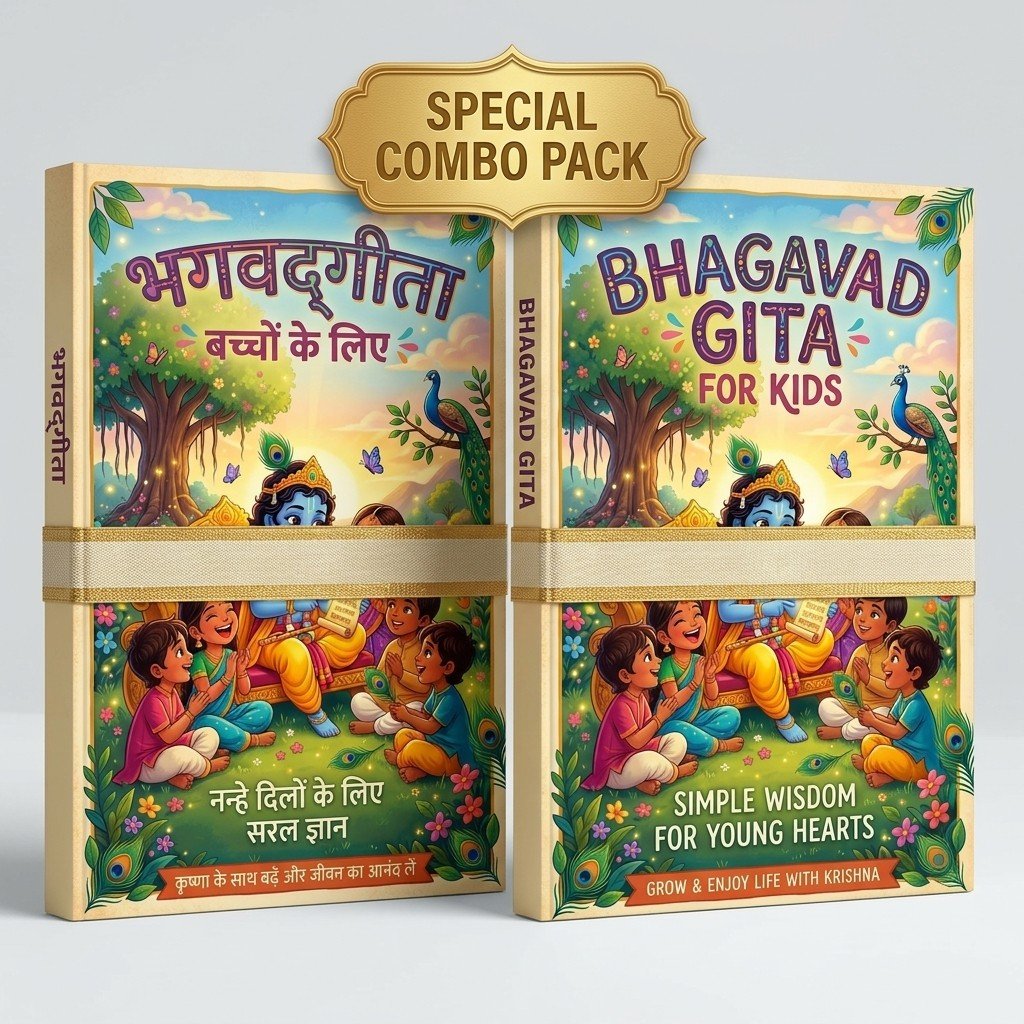
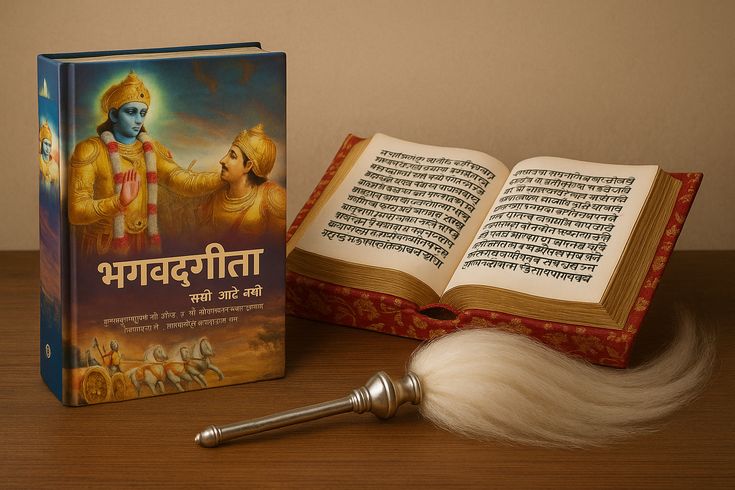
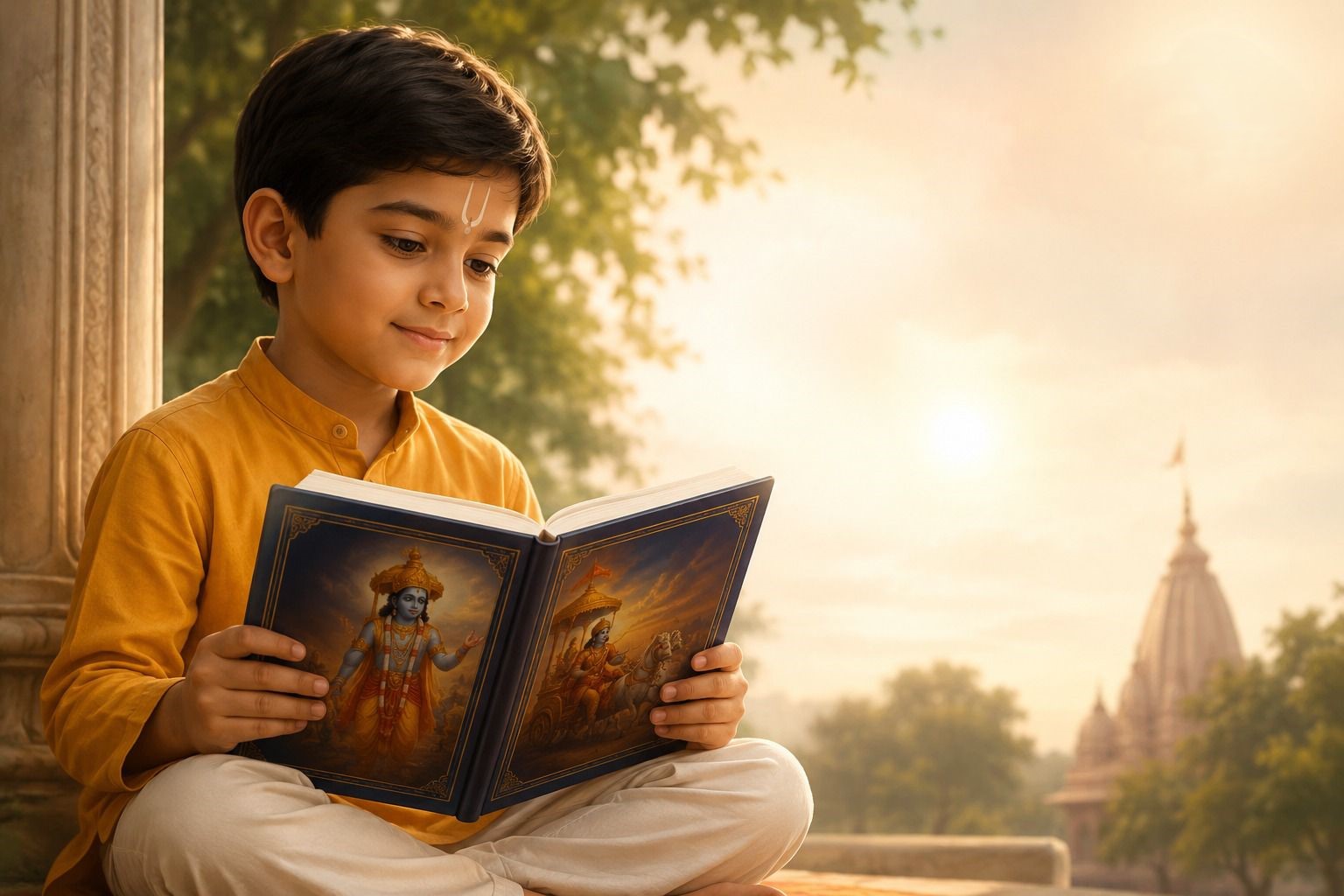
The Bhagavad Gita for kids is a discourse on the battlefield regarding duty, doubt, and doing without being attached to the result. That’s a lot to expect from a five-year-old, so the version is far more important than the verse.
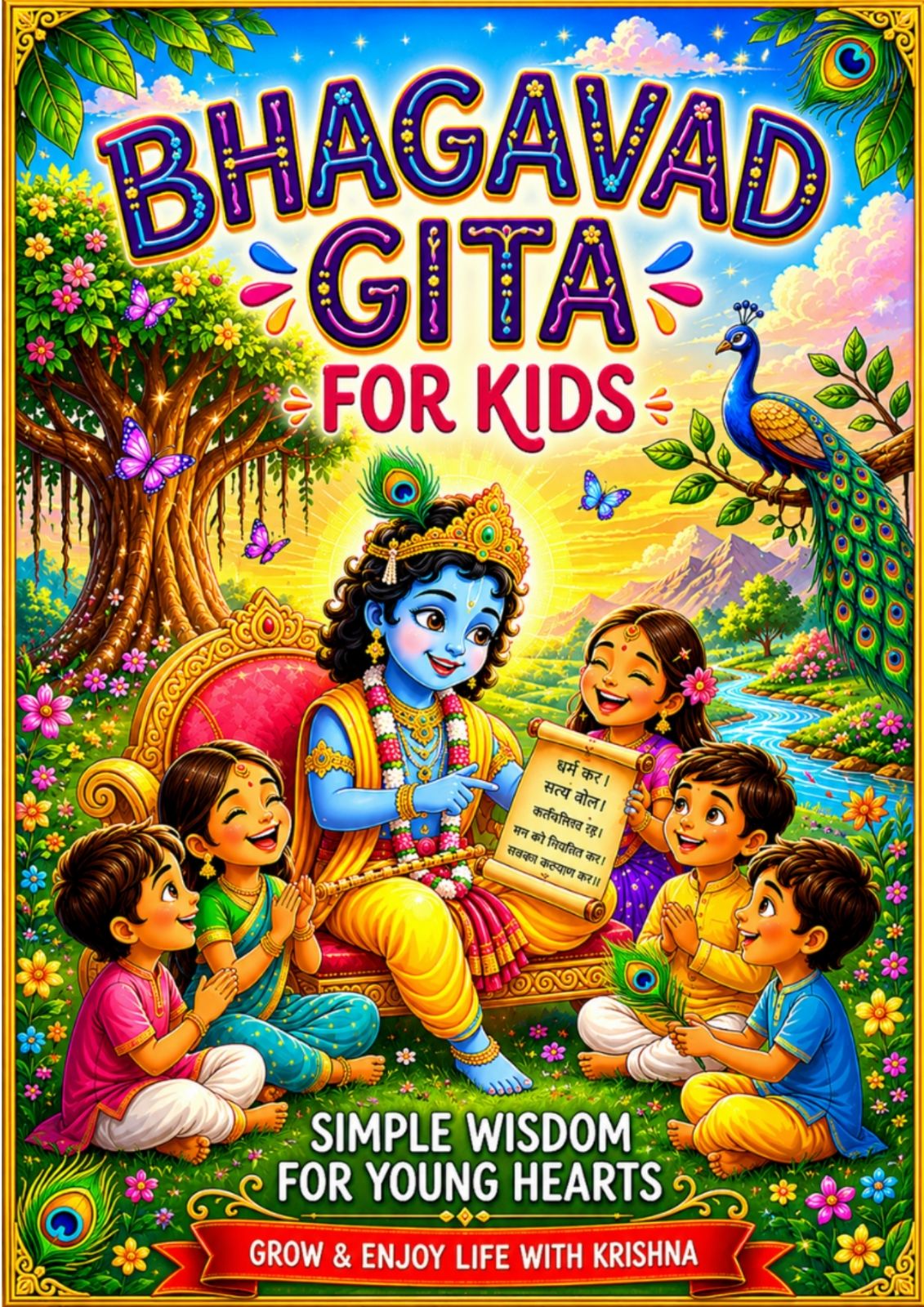
For children between 4 and 8 years old, the right approach is one where Krishna and Arjuna are presented as friends and mentors. According to BookSetGo, the Pegasus version of this book has been created using stories associated with Lord Krishna and the message of Bhagavad Gita in clear language with the help of illustrations. At 8 years old, children can benefit from a picture book that has reflective questions at the end of each part, and the listing for the Shubha Vilas version includes such questions.
Our view at Soul and Mind: hold back the war scenes and the idea of detachment until a child asks about them. Let “Why didn’t Arjuna want to fight?” be the way in. You don’t need to practise any particular faith for that question to be worth discussing, since it’s really about doubt and courage. You can see our own titles on Bhagvad Gita for Kids.
Reading it together
Read the book by yourself first, just in case there is a difficult question that might surprise you. But keep it simple: one page, one question, such as “What would you have done?” It is fine for your kid to disagree. When there is no longer any interest, stop. Ten minutes is better than thirty.
But if the book generates real fear or sorrow, stop and talk to your child’s school counselor or another professional instead of proceeding.
Teachers can also use this strategy. Read for ten minutes and ask a single question in a value education session. Please go to our program page to see how Soul and Mind organizes secular spirituality awareness classes in all schools in Gurgaon and Delhi NCR.
Start with one book this week
Choose one book that matches your child’s age, interests and understanding. Read it together, ask one simple question, and give your child room to share their thoughts.
If you’re exploring value-based learning for children, discover our Bhagavad Gita books for kids. Schools and colleges can also explore Soul & Mind programs focused on values, self-awareness and emotional well-being.
The goal isn’t to finish a book quickly. It’s to start a conversation that stays with your child.












0 Comments