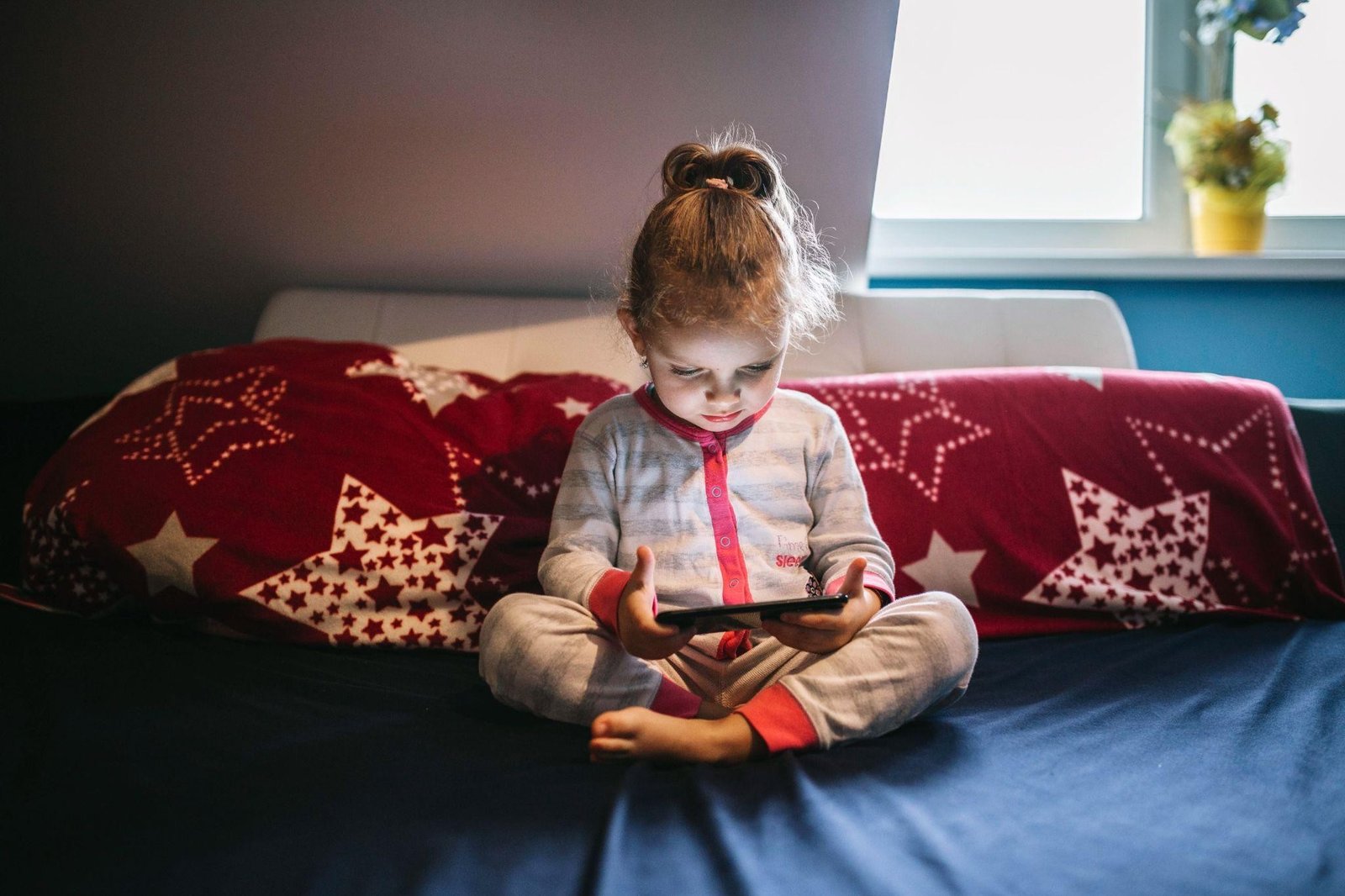
Screen time management for kids India is becoming increasingly challenging for parents who find themselves in the same small conflict most evenings. Homework is finished, or nearly finished, and you ask your child to put their phone away, only for them to say "five more minutes" and then twenty.
Online recommendations are largely some variation of "set a timer and be resolute," and if that worked, we wouldn't be here. So let's look through some other options.
First, we'll consider the suggestions of the Indian Academy of Pediatrics (IAP). Second, we'll explore ways in which the stillness we invite our students to during our mindfulness sessions can help parents establish rules for screen use that are more broadly adhered to.
Why Screen Time Management for Kids India Is Complicated in a Shared Household
Let's consider your shared phone, if you have one, or the one your child has access to otherwise. It serves multiple purposes: the grandmother's WhatsApp videos, the father's professional conference calls, and the school's WhatsApp group for the class, with your child caught in the middle for their homework, or claiming it to be for their homework.
"Keep it away" is not an option if the same phone carries the school's circulars.
The Indian Academy of Pediatrics released screen time guidelines for Indian children in March 2022 in the journal *Indian Pediatrics*. The authors note that exposure to screens at a young age and for more than one to two hours per day appears to be the norm.
They base this on a study conducted among teenagers in an urban resettlement colony in Delhi. Of these, 76.4% watched TV during meals, while rules about TV viewing were reported by only 22.9% of families. Further, on holidays, the teens spent an average of 3.9 hours per day on screens, compared to 3.2 hours on a school day.
It is, of course, only one colony in one city, and one would not extrapolate national averages from that data. However, the combination of screens in daily life with a lack of rules is broadly familiar to many parents.
The IAP Recommendations, by Age
If you are looking for screen time management options that do not require a degree in paediatrics, the IAP recommendations are a good place to start.
| Age Group | IAP Recommendation |
|---|---|
| Under 2 years | No screen time, apart from the odd video call with relatives. |
| Older than 2 and up to 5 years | Up to 1 hour of supervised screen time, in 20–30-minute segments. |
| 5 to 10 years | Less than 2 hours per day, including screen-based homework. |
| Older than 10 up to 18 years | No hard limits, but outdoor activity of at least an hour, 8–9 hours of sleep at night, and time for studies, meals, hobbies and family are recommended. |
The last recommendation is the most interesting, as for children older than 10 up to 18 years, the IAP does not recommend limiting screen time per se. Instead, it asks parents to consider what else is being displaced: if outdoor activity, studies, hobbies, or family time are being cut, then screens should be limited accordingly.
We would agree with this approach, as an hour of online maths is not the same as an hour of maths online.
Digital Wellbeing Children Can Practise, Not Only Follow

Digital wellbeing is the term the IAP uses for health and safety while using digital devices and responsible behaviour online. It is, however, difficult to time-limit digital wellbeing. Practice during the teens often comes down to the ability to notice the pull towards the screen and the ability to resist it, at least some of the time.
That is where the stillness we encourage in our mindfulness for students comes in, and it does not have to be anything as formal as a cushion or incense.
Screen time management in Indian households can begin with observing that many children pick up their phone out of habit, and that a few conscious breaths can interrupt that habit.
Before opening the application, take five slow breaths in and out. Five slow breaths for a younger child, counting each on their fingers. Five slow breaths for a teenager, who will probably roll their eyes for the first week, and that is okay.
It is one of the gentler ways of helping teenagers reduce screen time.
Another way to help a 14-year-old spend less time on screens is to allow space for boredom. The IAP guidelines state that screens must not be used to occupy children, and boredom is fertile ground for exploring one's imagination.
When the child says they are bored, wait ten minutes before offering anything that involves a screen. It is much harder on the parent than the child, but we ask that you try.
Finally, consider a half-hour quiet hour for the whole family, including the parents. Phones go into a basket somewhere out of sight, the lights are dimmed, and everyone sits comfortably, reading, drawing, or sipping chai on the balcony.
The IAP guidelines call this "digital fasting," recommend "individual/family choice," and suggest that schools encourage regular breaks or longer weekends. They further ask parents to lead by example, so your phone also goes into the basket.
How to Reduce Screen Time Teenager Households Can Actually Stick To
Taking the phone out of the teenager's hand mostly encourages them to hide it elsewhere. The IAP guidelines suggest, correctly, that children are more likely to comply when asked to follow rules set by adults respectfully.
Teenagers, in turn, should have a say in how they reduce screen time, so parents considering this option might begin by asking what a good evening would look like for their teenager.
The opening gambit of "You are on your phone too much" is unlikely to get anywhere.
Teenagers will mostly abide by what they help negotiate, and from the IAP guidelines, an initial agreement might look something like this:
- Two places in the house where phones are not allowed: The IAP suggests bedrooms, the dining table, the kitchen, the bathroom, and vehicles.
- No screens an hour before bedtime: This is because of the effect on melatonin.
- An hour of outdoor activity: Make outdoor time a regular part of the day.
- Homework before screens: Complete studies before using screens for entertainment.
- Family participation: Your phone is also not allowed at the dinner table.
The IAP guidelines ask parents to reduce their own screen time and set an example, and teenagers are more likely to comply if this part is not overlooked.
The first week may be challenging for everyone. After a week, sit down together and adjust one thing, and leave the rest for another week.
It is a slower process, but teenagers will find that they can live with these rules, even if they do not particularly like them. It has to begin somewhere.
Beyond a Habit: When Screen Time Management Requires More
For the most part, screen time management is a matter of developing new habits and breaking old ones. There are, however, times when the issue goes beyond a habit.
The IAP guidelines ask parents to look out for cyberbullying and media addiction, and advise consulting a paediatrician if their attempts to enforce screen time limits do not work.
Further, they highlight the importance of addressing underlying issues such as the impact on studies and extracurricular activities, and parents are encouraged to consult a mental health professional if media addiction is suspected.
Supporting children's digital wellbeing sometimes requires professional intervention, and seeking help is not a sign of weakness.
Our mindfulness sessions are intended to promote awareness and stillness, and are not a substitute for professional help.
If your child has been feeling persistently sad or anxious, or has been engaging in self-harm or other harmful behaviours, please seek help from a qualified mental health professional.
What Schools Can Do to Support You
Parents will find screen time management much easier to establish if the school authorities are assisting.
The IAP guidelines ask schools to encourage the use of traditional pedagogical tools alongside digital technology, prohibit bringing screens to school, and advise parents to consult their paediatrician in case of cyberbullying concerns.
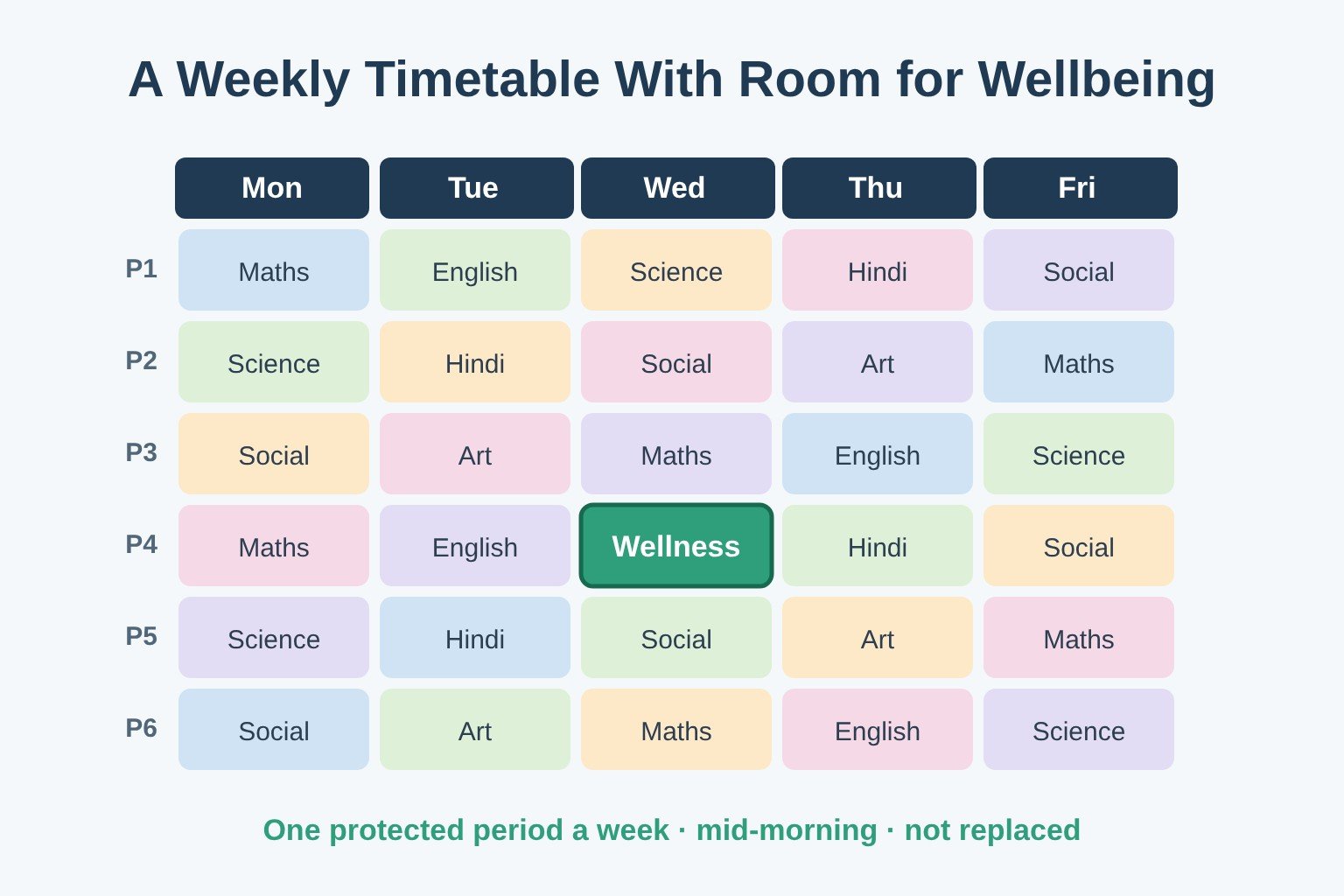
Further, the NCERT PRAGYATA guidelines ask schools to restrict online classes for Classes 1 to 8 to two sessions of 30–45 minutes, and to four sessions for Classes 9 to 12.
If your school has not shared any screen-time guidelines for parents, you may ask them to share. Schools looking for student sessions on focus, calm and healthy habits can explore our student wellness programs for schools.
A Beginning: Start with One Screen-Free Hour This Week
Choose a screen-free hour this week, tonight if you can. Ask your child what they would like to do with this hour, and once it is done, ask them what they thought of it.
You will learn much more from this conversation than from any weekly screen-time report. Parents can continue to build on such small agreements.
It will take some time, as healthy digital habits take time to develop. It is also true that one rotten week will not undo a month of mindful living.
If you would like to schedule a session on mindfulness for parents or your student groups, in Gurugram or elsewhere, explore our spiritual awareness in Gurugram. If your school has a similar requirement, please get in touch with us via the Soul and Mind website or our contact page.





















0 Comments